Why the Best Manufacturer in the Category Is Invisible on Google
A manufacturer with a twenty-year reputation asked me why two brands nobody had heard of were beating them in search. It wasn’t a trick.
A manufacturer with a twenty-year reputation asked me why two brands nobody had heard of were beating them in search. It wasn’t a trick. It was a sentence they had never written.
This kind of email turns up more often than you would think.
This one came from the owner of a company that makes industrial storage systems. Heavy-duty racking and mezzanines, the kind of steel you bolt into a warehouse floor and then forget about for a decade. They had been in business for twenty years, held every certification that mattered in their market, and had customers who had been with them since the start.
He had typed a question into Google that any of his buyers might type: average cost of a pallet racking system for a 10,000 square foot warehouse.
The results were full of two brands he had barely heard of, young companies three or four years old that import most of their product. His sales team had started hearing their names on calls. “They are not serious players,” he wrote. “So what are they doing to skew the results? Whatever it is, it’s working. We need to study that and copy it.”
It is a familiar question. The assumption is that there is a trick. There almost never is. What there usually is, is a sentence that one company wrote down and the other company didn’t.
This is a story about finding that sentence, and about why the companies with the most to say are so often the ones saying nothing.
Read the result page like a document#
I ran his query and read the whole result page, top to bottom, instead of skimming the first few links.
The first thing on the page was not a website. It was a row of product cards with photos and prices. A 10-bay starter system at $4,200, a 20-bay package at $7,900, a heavy-duty run at $12,500. Five sellers and five prices before a single blue link.
Then came the articles. A regional installer suggesting a budget of $15 to $40 per pallet position. A trade magazine piece from three years ago. A marketplace listing. And then, from one of the two upstarts, a guide published in 2022 with a sentence that stopped me.
For a standard warehouse, plan on roughly $8 to $12 per square foot for selective racking, installed.
There was the mystery, solved in one line. A four-year-old sentence with a dollar sign in it, sitting on a page with a question for a headline, had become Google’s answer to “what does this cost.” Every time a buyer asked, the upstart answered, and it would keep answering until someone wrote a better sentence.
I went back to my client’s website and searched it for the word “price,” then “cost,” then the dollar sign. Nothing. Thirty pages, a detailed FAQ, downloadable load tables, a warranty far better than the competition’s, and not one number a buyer could anchor to.
The search engine wasn’t skewed. It was answering the question that was asked. My client had never entered the conversation.
A good company, described badly#
A closer look at my client’s own site confirmed something that is common with manufacturers. The business was far better than the website said it was.
The Google Business Profile had dozens of five-star reviews. Customers wrote about engineers who drove out to re-measure a site for free. The steel was rolled domestically, the powder coat was applied in-house, and the design team held seismic certifications the imports could not match. This is a company with a story worth telling.
The website told almost none of it in a way a search engine could read. A few examples.
It never used the buyer’s words. Every page said “storage solutions.” Buyers type “pallet racking,” “warehouse shelving,” “mezzanine floor.” The phrase “pallet racking” appeared on two pages out of thirty. Google is good at synonyms and still prefers the page that uses the words people type.
It named its products after itself. The systems were called things like “Series 400” and “ProLine HD.” Fine names for a catalog. Almost nobody searches for them. Every page title was a model name followed by the company name, which is the digital equivalent of a shop sign that says only the owner’s surname.
It told the machines the wrong address. Buried in the page code was a structured-data block, the kind search engines and AI assistants read to understand who a company is. It listed the headquarters correctly, then declared the country as somewhere the company had once had a distributor. The phone number in that block did not match the one in the footer. A sister site for another market claimed the same address with no link back. From a machine’s point of view, there were two companies, one of them possibly foreign.
Every page had two headlines. A newsletter box in the footer had been built as a top-level heading, so every page on the site announced two subjects, one of which was “Join our mailing list.”
The best content was hidden. The FAQ answered forty real questions about load ratings, floor requirements, lead times and installation. Real expertise, clearly written by people who had answered these questions on the phone a thousand times. None of it was marked up so a search engine could use it, none of it appeared on the product pages, and none of it touched price.
None of these are hard to fix, which is what made the email hard to answer. The client assumed he was losing to a sophisticated opponent. He was mostly losing to a template setting and a missing page.
What the upstarts were actually doing#
I spent some time on the two competitors’ sites, looking for the trick my client was sure existed.
I didn’t find one. Neither site had structured data worth mentioning. One had a copy-paste error on its main product page that referred to a completely different product. Their content was thin. Their backlinks, as far as I could tell, were ordinary.
What they had was three habits.
They wrote the number down. One had published four separate cost guides, each with a table that gave a figure for a small warehouse, a mid-size one, and installation on top. Every section heading was a question a buyer would type. The newest one had the year in its title and a date two weeks old. The other brand put a “From $X” on every product listing.
They put the products where the shopping results look. Both had product feeds in Google Merchant Center, which is why their systems appeared as priced cards above the organic results. One also sold through a big-box marketplace, and the marketplace listings carried exact dimensions in the title. My client’s buyers who “kept mentioning” that brand were seeing it on a marketplace shelf, not Google’s.
They claimed geography. One brand had a page for every state it shipped to. When I searched for my client’s own company name plus his city, that competitor’s state page ranked above him. Above his own name. Not through any manipulation. My client simply had no page about his home state at all, despite having a factory there.
That was the whole secret. Publish prices, feed the shopping results, say where you are. The two brands weren’t gaming the system. They were the only ones in the category doing the obvious things, and the obvious things add up.
Five decisions, not a checklist#
The full audit ran to about forty items. But the conversation that mattered was about five decisions, and each one was uncomfortable in its own way.
1. Publish a price range, and accept that it will be wrong for someone. Custom manufacturers hate this. Every project is different, and a range feels like a promise. But a buyer who sees “$X to $Y for a typical 10,000 square foot layout” and then gets a quote inside that range trusts you more, not less. The buyer who never sees a number goes to the competitor who printed one.
2. Put standard configurations in the shopping results. The company already stocked common packages. Free listings in Merchant Center cost nothing beyond the setup time. A handful of products with real prices, photographed well, is enough to get the brand into a carousel that until now belonged entirely to competitors. Of the five, this is the quickest to act on and needs the least writing.
3. Rename the pages for the buyer, not the catalog. “Series 400” became “Heavy-Duty Selective Pallet Racking.” The model number stayed in the subtitle. Nothing about the product changed, only who could find it.
4. Tell the machines who you are, once, consistently. One company name, one address, one phone number, and one account of where the steel is rolled and the coating is applied. Write it on an About page (the site didn’t have one), repeat it in structured data that names the right country, and link the sister site properly so Google can tell it is the same company speaking another language rather than a rival.
5. Claim the ground you already stand on. A page for the home state and the factory. Pages for the seismic certifications that matter in certain regions. The company had earned each of these. It had just never said so anywhere a search engine would look.
None of this requires a bigger budget. It requires deciding that the website is a salesperson who should answer the question it was asked.
The gap in one picture#
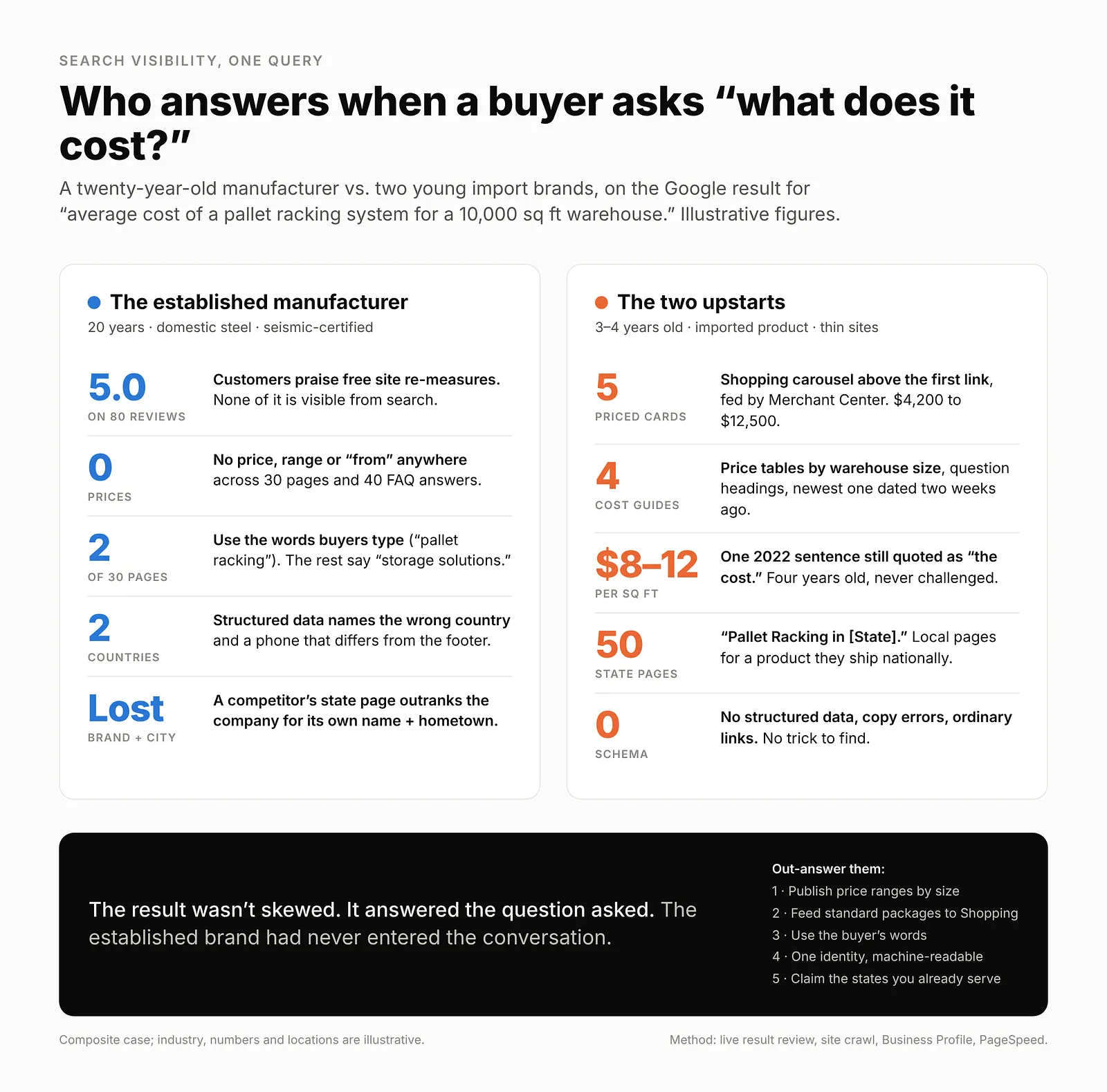
Side by side: an established manufacturer with no price on its site, and two young brands with priced product cards, dated cost guides and state pages. The established company has more to say and says less of it where search engines look.
The takeaway#
Search engines and AI assistants can’t test a product. They go with the clearest answer they can find. The competitors here didn’t outspend or outsmart anyone. They just answered the question.
The established company doesn’t need to copy them. It has more to say than they do. It only needs to say it where buyers are looking.